Upload any image and get an exact yarn yardage breakdown by color — automatically. No manual color percentages. No guesswork. The most complete free tufting tool available.
🖼️ Image → auto color analysis🧶 Yards + grams per color🔒 Aspect ratio lock💰 Rug pricing calculator🔫 Needle-to-yarn guide🖨️ Print shopping list
Built and maintained by Rytell Tools. Yardage figures use the density assumptions documented in this tool. About us & our method →
Everything in one place — built for serious tufters
Most tufting calculators make you guess color percentages by hand, only output yards, and don't help with pricing or technique. This tool does all of it automatically.
🖼️
Image → color analysis Unique
Upload any image and the tool automatically identifies your colors and calculates yards per color. No manual input required.
💰
Rug pricing calculator Unique
Enter your materials and time and get a suggested selling price for Etsy, craft markets, or custom clients — the only free tool that does this.
⚖️
Yards AND grams per color
Results show both imperial yardage and metric weight — works whether you buy by the skein, cone, or kilogram.
🔒
Aspect ratio lock
Lock your rug dimensions to your image's natural proportions so your design isn't stretched or squished in the final piece.
🪟
Transparent PNG support
Upload a PNG with a transparent background for irregular (non-rectangular) rug shapes — pixels outside the shape are excluded from the calculation.
🔫
Needle-to-yarn guide
Match your tufting gun needle to the right yarn weight, strand count, and pile height — the most common source of jams and uneven pile.
🧵
Strands held together
Correctly accounts for 1–4 strands fed simultaneously — the most common source of yardage calculation errors in basic tools.
🛒
Complete materials checklist
Beyond yarn — backing cloth yardage, latex quantity, frame size, and every supply you need, calculated for your specific rug dimensions.
🖼️ Step 1 — Upload your design image
🎨
Drop your image here or click to browse
JPG, PNG, GIF, WebP supported. Upload a transparent PNG for irregular (non-rectangular) rug shapes — pixels outside the shape will be excluded from the calculation.
📐 Step 2 — Rug dimensions & method
in W
in H
🔒 = aspect ratio locked to your image proportions. Click to unlock for custom dimensions.
Color analysis settings
3 colors16 colors
8
Lower = fewer, broader color groups. Higher = more precise color matching. Most tufting projects use 6–12 colors.
$
yd
Method tip: Tufting gun with cut pile at 3/8" pile height is the most popular method for beginners. It produces a plush, durable rug and the medium pile height is the most forgiving for detailed designs.
💰 Rug pricing calculator — what should I charge?
Whether you're selling on Etsy, at markets, or to custom clients — price your handtufted rugs properly. Enter your costs and time, and get a suggested retail price that actually covers your work.
in
in
$
$
$
$
hrs
$/hr
📊 Cost breakdown
💡 Pricing strategy guide
Why most tufters underprice
The most common mistake is pricing based on materials only, ignoring labor. At minimum wage, 12 hours of tufting is worth $145 in labor alone — before any materials. Your skill, artistry, and time deserve fair compensation.
The market reality
Handtufted rugs on Etsy range from $80 (underpriced) to $800+ for quality pieces. Buyers who appreciate handmade goods understand value — price to attract the right customer, not every customer.
Etsy fee structure
Etsy charges a $0.20 listing fee, 6.5% transaction fee, and ~3% payment processing. For a $250 rug, that's about $24 in fees. Factor this into your base price, not as an afterthought.
Custom rug pricing
For custom orders, add 20–30% above your standard pricing — custom work involves additional communication, design time, revisions, and deadline pressure. Never negotiate your labor rate for custom commissions.
🔫 Needle-to-yarn matching guide
Mismatched yarn and needle size is the #1 cause of jams, skipped stitches, and uneven pile. Use this guide to match your tufting gun needle to the right yarn weight, strand count, and pile height for clean, consistent tufting.
Needle size
Yarn weight
Strands
Pile height range
Best for
Jam risk
Fine / #9
Fingering / Sock (wt 1)
3–4 strands
5–10mm loop · 7–12mm cut
Very detailed work, lettering, fine art pieces
Low
Fine / #9
DK / Light worsted (wt 3)
2 strands
6–12mm loop · 8–14mm cut
Detail-heavy designs, portraits, small rugs
Low
Standard / #12
Worsted / Aran (wt 4)
2 strands
8–16mm loop · 10–18mm cut
Most beginner projects — forgiving, consistent
Medium
Standard / #12
Bulky / Chunky (wt 5)
1–2 strands
10–18mm loop · 12–20mm cut
Most popular combo — fast coverage, good pile
Medium
Large / #14
Bulky / Chunky (wt 5)
2–3 strands
12–20mm loop · 14–22mm cut
Thick, plush rugs — faster fill, less detail
Medium
Large / #14
Super Bulky (wt 6)
1–2 strands
14–22mm loop · 16–25mm cut
Maximum plush, abstract designs, fast projects
Higher
If your loops are falling out: Either your backing is too loose on the frame, your needle is too large for your yarn, or your yarn tension is inconsistent. Try increasing frame tension first — it's the most common cause and easiest fix.
🧵 Yarn material comparison
🐑 Wool — premium choice
Naturally resilient — springs back underfoot. Takes dye beautifully with rich, deep colors. Biodegradable. Naturally flame-resistant. Significantly more expensive ($15–40+ per skein). Recommended for heirloom and high-value pieces. Avoid machine washing.
🧴 Acrylic — beginner standard
Affordable ($5–12 per skein), huge color range, widely available. Machine washable — practical for floor rugs. Slightly less resilient than wool over time. Some grades pill. Best value for practice, large projects, and colorful decorative pieces. Avoid high heat.
🌿 Wool-acrylic blends
Best of both worlds — better durability than pure acrylic, lower cost than pure wool. Good color range. Slightly easier to tuft than 100% wool. Check shedding before committing to a large rug. A good step up from pure acrylic for intermediate tufters.
🌾 Cotton — avoid for floors
Cotton compresses permanently underfoot — pile won't bounce back after use. Fine for wall hangings and tapestries where foot traffic isn't a factor. Some tufters use it for punch needle work on smaller decorative pieces. Never recommended for floor rugs.
Quick test before buying: Pull a small length of yarn and tug it sharply — if it stretches and doesn't spring back, it's too elastic for tufting (common in cheap acrylic). Good tufting yarn has minimal stretch and a tight, even twist. Run it through your fingers — it should feel smooth with no slubs or texture variations.
Analyzing colors and calculating yarn requirements…
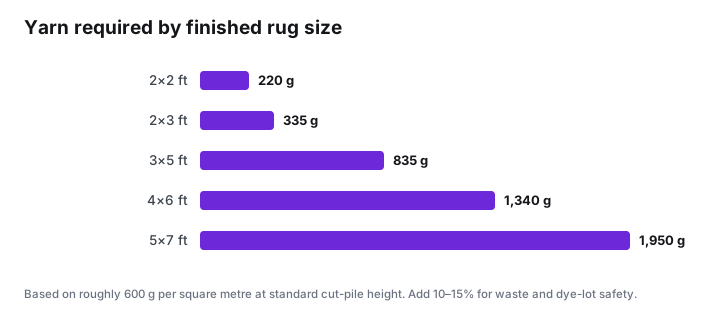
Yarn use scales with area, so doubling both dimensions roughly quadruples the yarn. Buy dye-lot extra before you start, not partway through.
Tufting Yarn Shopping List
Generated at tuftingcalculator.com
🎨 Color palette analysis
Original image
Simplified color map
Color matching tip: Use the hex codes above to match yarn colors at your supplier. Wool and acrylic yarns photograph slightly differently — bring a printout of the color palette to compare in-store. DMC color cards and Pantone color guides can help bridge the gap between digital and physical color.
💰 Estimated project cost
🛒 Complete project materials checklist
Everything you need beyond yarn — quantities calculated for your specific rug size.
Buying tip: Don't buy everything at once for your first project. Start with yarn, backing cloth, and a frame — then add the finishing supplies (latex, secondary backing) once your tufting is complete. This way you're not storing unused materials if you adjust your approach mid-project.
Yarn density reference guide
How yarn density affects yardage
The tufting method and pile height dramatically affect how much yarn a project consumes. Use this table to understand the tradeoffs — longer pile heights create a plusher rug but use significantly more yarn.
Method
Pile height
Yards per sq in
Yards per sq ft
Best for
Punch needle (fine)
1/8"–3/16"
~2.0
~288
Detailed art, wall hangings, tight designs
Punch needle (medium)
1/4"
~2.5
~360
General rugs, medium detail, most beginner projects
Tufting gun — loop
3/16"–1/4"
~2.0
~288
Durable rugs, commercial-style, quick coverage
Tufting gun — cut pile low
1/4"
~3.0
~432
Detailed designs where low pile aids image clarity
Tufting gun — cut pile medium
3/8"
~3.75
~540
Most popular — plush feel, good detail, durable
Tufting gun — cut pile high
1/2"
~4.5
~648
Maximum plush, luxury feel, abstract or bold designs
Cut pile, very high
3/4"
~6.5
~936
Sculptural effects, extreme plush — high yarn consumption
Rule of thumb: For every 1 square foot of rug at medium cut pile (3/8"), budget approximately 540 yards of yarn across all colors combined. A 24×36 inch rug (6 sq ft) at this pile height uses roughly 3,240 yards total — about 15 standard 220-yard skeins.
📏 Pile height visual comparison
Pile height is the single biggest factor in how much yarn your project uses — and how your finished rug looks and feels. Here's an accurate scale comparison of the most common pile heights.
Pile heights shown to scale. Higher pile = more yarn, plusher feel, less design detail resolution.
Tufting beginner guide
Everything you need to start tufting
🔫 Choosing a tufting gun
AK-I (cut pile) and AK-II (loop pile) are the most popular entry-level guns. Cut pile guns are more beginner-friendly — they cut the loops automatically. Loop pile guns are faster but require manual cutting for a finished look. Budget $80–$200 for a quality starter gun.
🧵 Best yarn for tufting
Bulky acrylic yarn is the most popular choice — affordable, colorfast, and easy to work with. 100% wool is preferred for high-end rugs (naturally durable and takes dye beautifully). Avoid cotton for floor rugs — it compresses badly underfoot. Look for smooth, tightly spun yarns without texture.
🖼️ Monk's cloth vs primary backing
Monk's cloth is the most beginner-friendly backing — its open weave is easy to punch through and the looseness gives good grip. Primary tufting cloth is tighter and more professional but requires a sharp needle. Both come in widths of 60–72 inches for large projects.
🔒 Finishing — latex backing
After tufting, apply rug binding latex to the back of the piece with a foam roller. This locks every loop permanently and prevents shedding. Let it cure 24–48 hours before trimming and adding a secondary fabric backing. Skipping this step means loops will pull out with use.
🎨 Transferring your design
Project your image onto the backing cloth using a projector or lightbox and trace with a fabric marker. Alternatively, print your design at scale and use a light table to transfer it. Keep lines bold and simple — fine details smaller than 1/2 inch are hard to execute cleanly with a tufting gun.
✂️ Trimming cut pile
After tufting, use carpet scissors or electric fabric scissors to trim the pile to an even height. Work in sections with good lighting — a raking light at an angle helps you spot uneven spots. For sculptural effects, carve into the pile at different heights to create depth and dimension.
🧶 How much backing to buy
Buy backing cloth 6–8 inches larger than your finished rug on all sides. You need this margin to stretch the backing tightly on the frame. A 24×36 inch rug needs at least a 36×48 inch piece of backing cloth. Most backing cloth is sold by the yard at 60" width.
🖼️ Frames and stretcher bars
Attach backing cloth to a wooden frame using carpet tacks or a staple gun, pulling tightly for even tension. PVC pipe frames are budget-friendly; wooden frames with adjustable bars are more professional. A loose frame creates uneven pile height and makes the gun harder to control.
Frequently asked questions
What is the best tufting gun for beginners? ▼
The AK-I (cut pile) and AK-II (loop pile) are the most widely recommended beginner tufting guns, typically priced between $80–$150. The AK-I is generally the better starting point — it automatically cuts the loops as you tuft, eliminating a finishing step. The Duo tufting gun (cuts both cut and loop pile) is a popular step-up option for those who want versatility. Avoid very cheap guns under $50 — the mechanism jams frequently and the needle quality is poor. Whatever gun you choose, make sure you can source replacement needles, as they dull over time. Most beginners get 3–5 projects from a single needle before needing a replacement.
What is monk's cloth and do I need it for tufting? ▼
Monk's cloth is a loosely woven cotton fabric used as the primary backing for tufting projects. Its open, even weave allows the tufting needle to pass through easily and consistently — this is what you stretch on your frame and tuft into. It's the most beginner-friendly backing material because the loose weave is forgiving and the natural fiber has good grip. The alternative is "primary tufting cloth" — a tighter, synthetic mesh that gives a more professional result but requires a sharper needle and more precise tension. Both are stretched onto a frame before tufting. After tufting, you add a secondary latex backing and optional fabric lining on the reverse — the monk's cloth itself is never visible in the finished piece.
How long does it take to tuft a rug? ▼
Time varies significantly based on rug size, design complexity, and your experience level. As a rough guide: a 12×12 inch sampler takes 1–2 hours. A 20×30 inch accent rug with simple design takes 6–12 hours. A 24×36 inch rug with medium detail takes 10–20 hours. A large 36×60 inch rug can take 30–60+ hours. These are tufting time only — add 2–4 hours for design transfer, frame setup, latex application, and finishing. Most tufters work in sessions of 2–4 hours at a time. A tufting gun is significantly faster than punch needle — roughly 3–5x faster for the same area. Your first project will always take longer than subsequent ones as you develop technique and muscle memory.
Do I need rug binding latex and what does it do? ▼
Yes — rug binding latex (also called rug backing latex or carpet adhesive) is essential for any tufted piece you want to use or display long-term. After tufting, the yarn loops sit in the backing cloth but aren't permanently secured — they can pull out with use or handling. Applying latex to the back creates a permanent bond that locks every loop in place. Use a foam roller to apply an even coat across the entire back surface, working it into all the gaps. Let it cure for 24–48 hours. Once set, the latex also provides structure and prevents the backing cloth from fraying. After the latex cures, you can add a secondary backing fabric (felt, non-slip rug backing, or canvas) using the same latex or craft glue for a clean, professional finish. Never skip this step for floor rugs — the yarn will shed and loops will pull out within weeks of use.
How much yarn do I need for a tufting rug? ▼
The amount of yarn depends on three factors: the rug's surface area, the pile height (method), and the number of colors. As a general estimate: at medium cut pile (3/8"), budget approximately 540 yards per square foot of finished rug. A 24×36 inch rug (6 sq ft) needs roughly 3,200–3,500 yards total. Always add 15–20% for waste, errors, and having a small reserve of each color for repairs. The calculator above provides a color-by-color breakdown based on your specific design, which is far more accurate than a flat estimate.
What type of yarn is best for tufting? ▼
For most tufting projects, bulky-weight acrylic yarn (sometimes called "chunky") is the most practical choice — it's affordable, widely available in hundreds of colors, washable, and durable underfoot. 100% wool yarn produces a premium result and is naturally resilient and biodegradable, but costs significantly more. Avoid yarn with texture (bobbles, slubs, or novelty fibers) as it catches in the tufting gun mechanism. The yarn should be smooth, tightly spun, and uniform. Most experienced tufters use yarn labeled "bulky" (weight 5) or "super bulky" (weight 6) for floor rugs.
What's the difference between cut pile and loop pile tufting? ▼
Loop pile tufting leaves the yarn loops intact — the result looks like a commercial carpet or Berber rug and is extremely durable. Cut pile tufting cuts each loop, creating a plush, velvet-like surface where individual yarn fibers stand upright. Cut pile is the more popular finish for decorative tufted rugs because it creates a rich, dimensional look and shows design details more clearly. Most tufting gun projects use cut pile — the gun cuts as it tufts. Loop pile guns are faster but require a secondary cutting step for a finished look. For wall hangings and tapestries, cut pile is almost always preferred for its visual softness.
How accurate is this yarn calculator? ▼
The calculator provides a solid planning estimate based on established yarn density constants for each tufting method. In practice, actual yarn usage varies based on your specific yarn's twist and ply, how consistently you tuft, your gun's speed setting, and how tightly you stretch your backing. We recommend the 15% waste buffer for experienced tufters and 20–25% for beginners or complex, highly detailed designs. For a very large or expensive project, tuft a small test swatch (6×6 inches) and measure your actual yarn usage per square inch before ordering all your yarn.
How do I choose the right number of colors for my design? ▼
This depends on the complexity of your source image and your skill level. For a beginner, 4–6 colors is highly manageable and produces clean, graphic results. 8–12 colors allows for more naturalistic shading and detail in things like landscape scenes or portraits. Above 12 colors, the transitions become very fine and difficult to tuft clearly with a gun — you'd need punch needle for that level of detail. The color count slider in the calculator lets you preview how your image simplifies at different color counts. For most decorative tufted rugs, 6–10 colors hits the sweet spot between visual interest and practical execution.
What size should my tufting design be? ▼
The most common beginner rug sizes are 20×30 inches (a small accent rug) and 24×36 inches (a standard bath/accent rug). For a first project, stay under 4 square feet — it keeps yarn costs manageable and lets you finish before losing momentum. Large rugs (4×6 feet and above) use thousands of yards of yarn and can take 40–100+ hours to complete. Wall hangings and tapestries can be any size, but the framing constraints of your tufting frame are typically the limiting factor. Most beginner tufting frames accommodate designs up to 24×36 or 30×40 inches.